
A connected property intelligence workflow
Tellingly brings discovery, property research, entity resolution, market context, scenario analysis, monitoring, and reporting into one evidence trail so teams can move from a first signal to a recorded decision.

See how evidence moves from signal to decision
The following screens show the working analyst environment: prioritising the day, screening opportunities, opening a property record, reviewing the evidence argument, and testing the commercial case.
Representative screens use demonstration data from the protected analyst portal. They show real product interactions and layouts without publishing private customer records.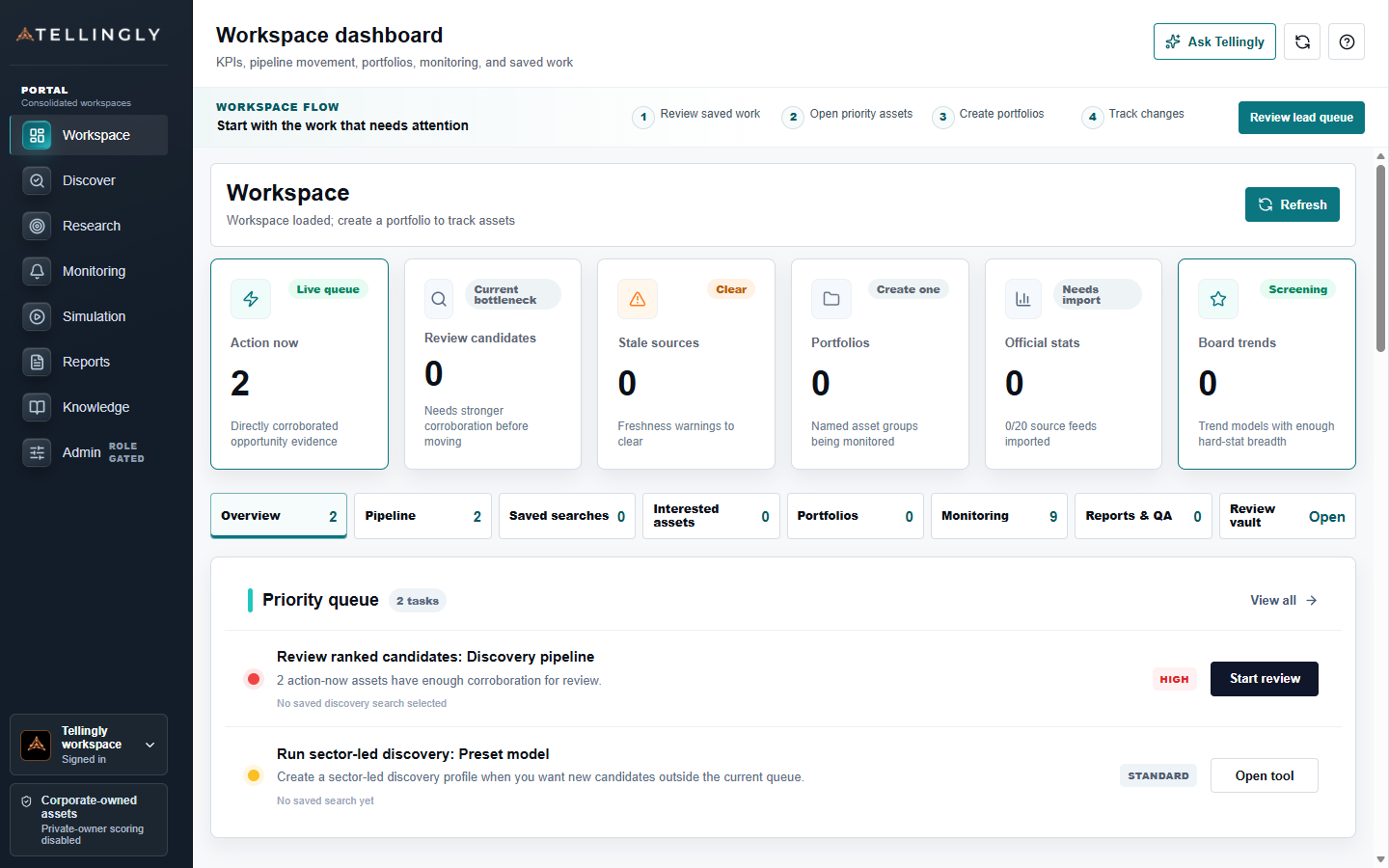
Begin with the work that needs attention
The daily workspace brings the live queue, saved research, monitoring, source readiness, portfolios, and reporting tasks into one ordered review. It is designed to answer a practical first question: what deserves analyst attention now?
- Prioritised daily work queue
- Source-readiness and monitoring indicators
- Saved research, portfolios, and review vault
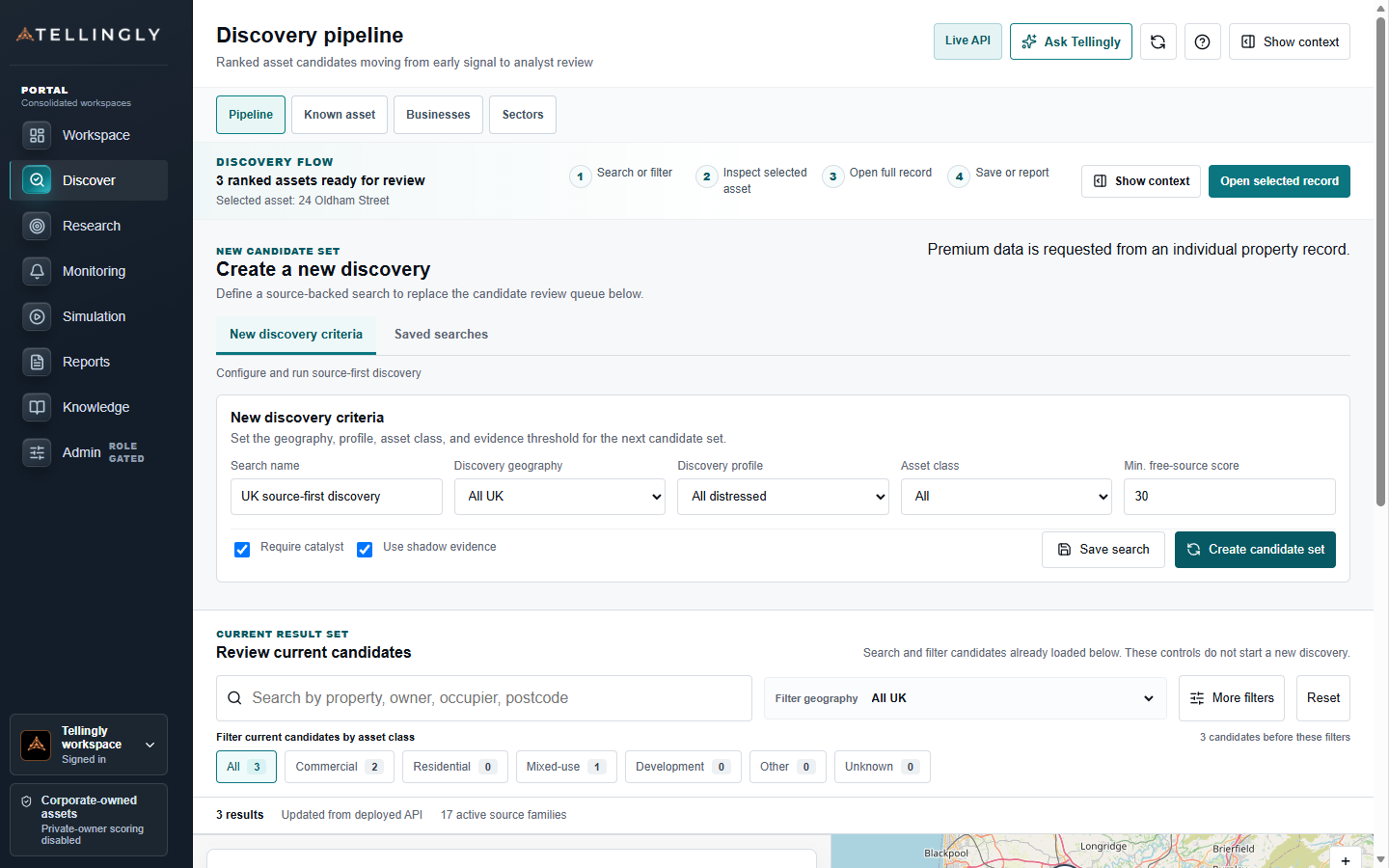
Review ranked opportunities in context
Discovery combines a ranked lead queue with search criteria, geography, map context, catalysts, evidence coverage, and screening status. Analysts can see why a property appeared before deciding whether to open the full record.
- Source-backed candidate ranking
- Map-linked property screening
- Search definitions that can be saved and rerun
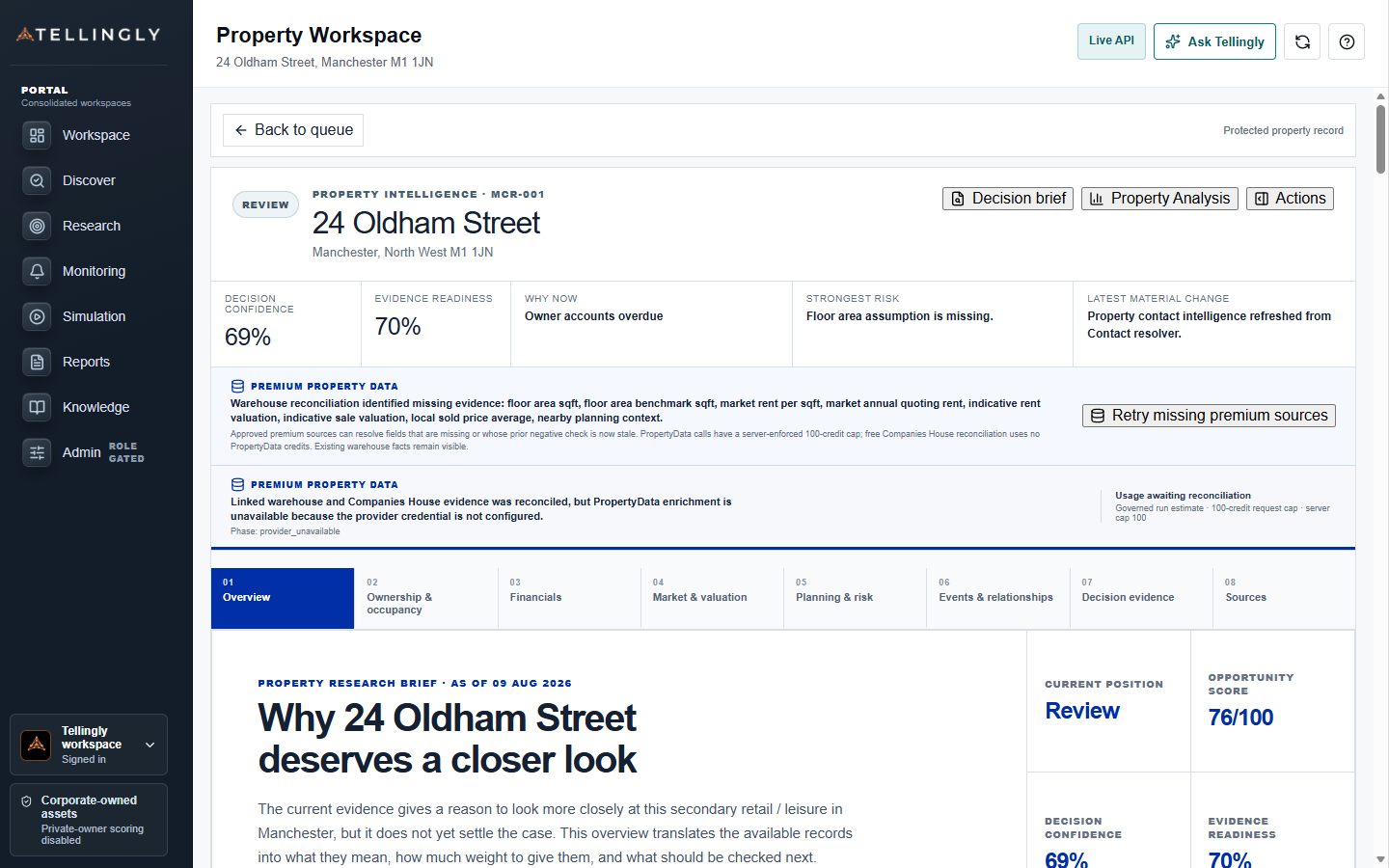
Open a source-aware property record
The Property Workspace keeps identity, ownership, occupancy, financial, market, planning, relationship, source, and decision views tied to the same property evidence revision. Headline conclusions remain beside the confidence and gaps that qualify them.
- One sectioned property intelligence record
- Visible enrichment and evidence readiness
- Direct access to analysis, actions, and sources
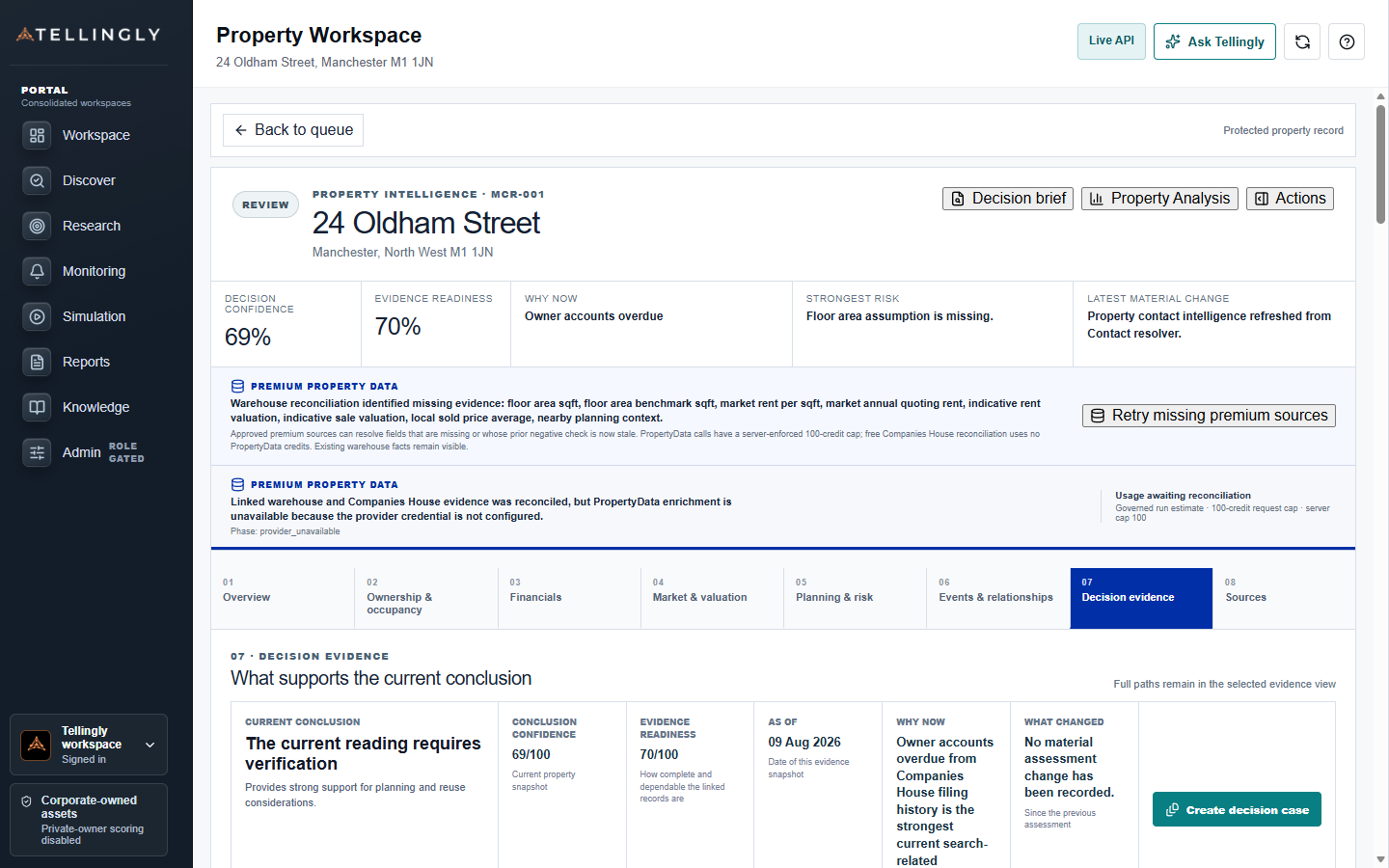
Understand how the conclusion was built
Decision Evidence translates the technical record into a readable conclusion, then separates decisive support, corroborating context, counterevidence, and genuinely unresolved questions. Reviewers can inspect the source and decision impact behind each observation.
- Plain-English evidence synopsis
- Supporting evidence and counter-case kept separate
- Source provenance and unresolved actions
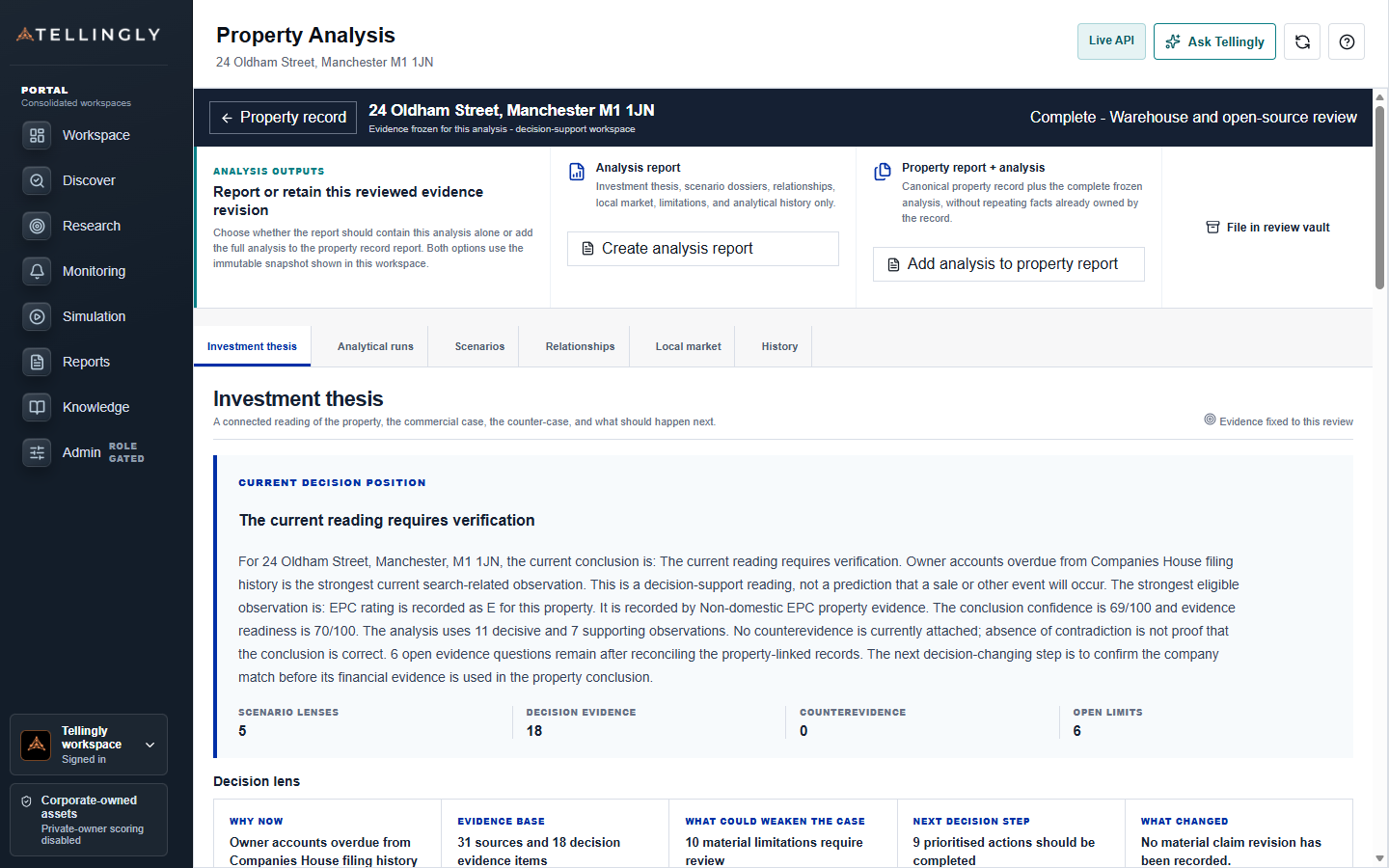
Test the commercial case on a frozen evidence revision
Property Analysis turns the property record into a decision-support workspace. The investment thesis connects the current reading, scenario readiness, ownership and occupation, commercial implications, analytical indicators, limitations, and a verification plan without losing the underlying evidence boundary.
- Connected investment thesis and counter-case
- Scenario-specific decision readiness
- Immutable reports and review-vault filing
- Scope
- Six connected analytical capabilities
- Evidence posture
- Source-linked, scoped, and reviewable
- Decision output
- A traceable record of what to do next
Executive overview
Property decisions rarely begin with a complete dossier. They begin with a change: a corporate filing, a planning event, an ownership movement, a market shift, a vacancy signal, or a question about a known address. Tellingly is designed to assemble those separate observations into a coherent review without pretending that every source proves the same thing.
The workflow keeps the selected property, its owner, its possible occupier, its local market, and its wider sector in distinct analytical roles. That distinction matters because an event affecting a parent company is not automatically an event affecting a property, and a postcode benchmark is not automatically a valuation of the selected asset.
- Begin with a broad search, a known address, a business, a sector, or a saved review.
- Follow the evidence into the relevant property, entity, market, or scenario workspace.
- Retain supporting evidence, counterevidence, conflicts, and unresolved questions together.
- Create monitoring records and decision artifacts from the same evidence revision.
Discover and qualify earlier
Opportunity discovery is the broadest part of the workflow. It screens a source-backed candidate universe, explains why each result appeared, and separates hard catalysts from contextual indicators. Analysts can inspect a ranked queue, map the returned assets, filter the current result set, and save the search definition for later comparison.
A result is an invitation to review, not a conclusion. Tellingly therefore exposes the signal mix, linkage confidence, geography, evidence coverage, and strongest gaps before the user opens a full record.
- Discovery pipeline for source-backed candidate sets.
- Known Asset Finder for a user-supplied address.
- Business and sector research using shared search and evidence patterns.
- Saved searches for repeatable review rather than one-off browsing.
Resolve the subject before relying on it
Selected assets move into a subject-resolution workflow. UPRNs, title numbers, addresses, ownership rows, rating records, energy records, company addresses, and approved premium-source responses can corroborate an identity. Where the match remains uncertain, candidate records stay visible for review and are excluded from property-specific conclusions.
This creates a practical distinction between direct property facts, analyst-confirmed facts, candidate matches, building evidence, geographic context, historical observations, and excluded records. Users can still learn from contextual evidence while seeing exactly what must be verified before it is used as a property fact.
Build the commercial and strategic case
Property Intelligence brings identity, ownership, occupation, financial, market, planning, physical, event, and source information into one sectioned workspace. Property Analysis then tests investment theses, relationships, local-market conditions, and alternative scenarios against a frozen evidence revision.
Scenario work is structured around the decision case rather than a generic score. Each eligible option can expose its evidence model, assumptions, financial readiness, risks, sensitivities, delivery dependencies, and decision gates. Missing inputs remain visible; they are not silently replaced by invented values.
- Explain why an option is relevant and what would have to be true for it to work.
- Separate observed values, contextual benchmarks, derived measures, and analyst assumptions.
- Retain a counter-case and reasons not to proceed.
- Connect risks and milestones to accountable verification actions.
Monitor change and communicate the decision
Monitoring is used when a reviewed asset or entity needs continuing attention. It records the subject, the evidence position, the material-change question, and the analyst's interest without confusing a saved review with an alerting rule. The Workspace surfaces concise summaries; the Monitoring area holds the detailed review state.
Reports are generated explicitly from an immutable snapshot. A board pack, property report, contextual asset report, or scenario dossier should carry the same facts, limitations, and source references as the screen from which it was created. Historical artifacts remain unchanged so later users can understand what evidence was available at the time.
Governance is part of the product
Tellingly is decision-support infrastructure, not a substitute for valuation, survey, legal, planning, tax, lending, or investment advice. The product is therefore designed to show scope, provenance, freshness, confidence, conflicts, and reliance limits close to the conclusion they qualify.
A strong workflow is not one that always produces an answer. It is one that makes the current evidence legible, prevents weak links from becoming headline claims, identifies the next verification action, and leaves a reproducible record for review.