
Carry the evidence from review into monitoring and reporting
Tellingly preserves the reviewed evidence revision, records what should change the decision, and generates report artifacts from the same frozen facts, findings, assumptions, risks, and limitations seen by the analyst.

Retain the reviewed position and make later change explainable
The daily workspace surfaces changed assets, source warnings, retained reviews, portfolios, recent reports, and operational attention. Detailed monitoring and immutable reports preserve what changed and how it affected the decision.
Representative interface using demonstration data from the protected analyst portal.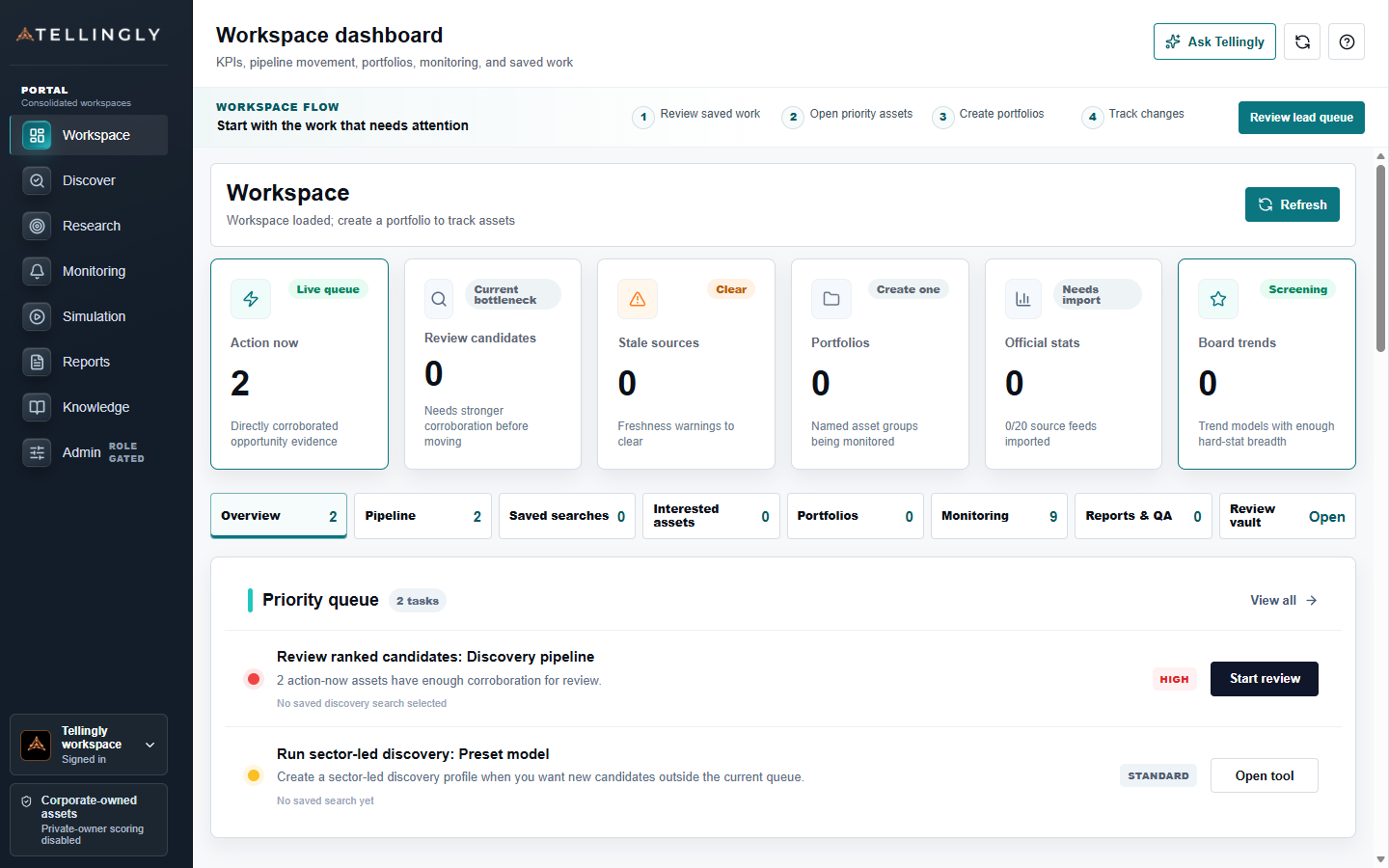
Return to reviewed work without rebuilding the evidence context
The workspace keeps monitoring activity, saved research, review-vault items, report history, portfolios, and source readiness close to the live queue. A monitored asset can be compared with its earlier evidence revision, while a retained review can be reopened without creating an alert. Reports remain separately versioned immutable artifacts.
- Changed assets and source warnings
- Review Vault and saved-work continuity
- Recent immutable reports and portfolio activity
- Primary question
- What changed, and does it alter the decision?
- Continuity control
- Screen, report, and download share one snapshot
- Decision output
- A review history and reproducible board artifact
Preserve the reviewed position
A property or business that has been analysed may need to be retained for future reference without becoming a live alert. The Review Vault files the selected evidence revision into a user-named and automatically categorised container. Monitoring is separate: it records an active interest and the changes that should prompt attention.
This distinction prevents a saved research item from silently creating an alert and allows analysts to return to the exact evidence position they previously reviewed.
Define material change
Monitoring is most useful when the user can explain what matters. A review may focus on ownership, occupation, financial health, insolvency, planning, listing or disposal, market movement, source freshness, or another governed event family. The current reading, trigger, risk, and unresolved gaps form the baseline.
When new evidence arrives, the platform should distinguish a refreshed source from a material change. Users can inspect what changed, which conclusions were affected, and whether a follow-up action, escalation, or revised report is required.
Workspace summary and detailed monitoring
The Workspace provides a concise daily view of changed assets, saved work, recent reports, source warnings, and operational attention. It is an overview rather than a second monitoring product. Detailed rules, event history, status, ownership, and review actions remain in the Monitoring workspace.
This keeps the analyst's daily starting point legible while preserving the detailed evidence trail needed to understand an alert.
Reports are explicit, immutable artifacts
Report generation is always an explicit action. The user selects the report family, scope, evidence snapshot, template, scenarios, and where required a board question or analytical brief. Opening a property or reading a screen does not silently prepare or spend resources on a report.
Once generated, HTML and PDF read the same presentation manifest. The artifact records its snapshot, composition and renderer versions, creator, generation time, checksum, quality status, and supersession state. Repeated downloads of the same artifact remain identical.
- Property reports explain the selected asset and its canonical evidence.
- Asset Intelligence Board Packs cover the contextual or confirmed asset case and option set.
- Scenario dossiers focus on one option's case, economics, risks, and delivery gates.
- Due-diligence templates add full evidence, provenance, assumptions, and model registers.
Readable board communication
A board-oriented report begins with the decision requested, management posture, principal rationale, counter-case, confidence, leading risks, and next action. Narrative sections explain the evidence before technical appendices provide complete registers. Charts, maps, tables, timelines, and risk views are included only when supported by the frozen data.
Occurrence rules prevent the same fact from being repeated as a card, bar, table, and paragraph. A compact cover reference can lead to one detailed occurrence; later references point back to the owning section.
Audit, limitations, and history
Every artifact retains its evidence scope. Candidate and contextual records may be discussed but cannot silently become direct property facts. Automatic assumptions remain labelled as assumptions, and unresolved identity constrains the recommendation to a contextual position.
Historical artifacts are never rewritten when models, sources, or wording change. A new report supersedes the earlier artifact while preserving the former decision record, allowing reviewers to compare what changed and why.