
Compare property strategies as decision cases, not slogans
Scenario Analysis tests eligible uses and strategies against the same frozen property and place evidence, then sets out the commercial thesis, assumptions, economics, risks, sensitivities, counter-case, and conditions required to proceed.

Test an option without detaching it from the frozen evidence
Scenario analysis turns the property or known-asset review into a structured case for acquisition, retention, repositioning, conversion, specialist reuse, redevelopment, financing, exit, or monitoring where the evidence supports those questions.
Representative Property Analysis screen using demonstration data. Scenarios are decision support and do not constitute formal advice.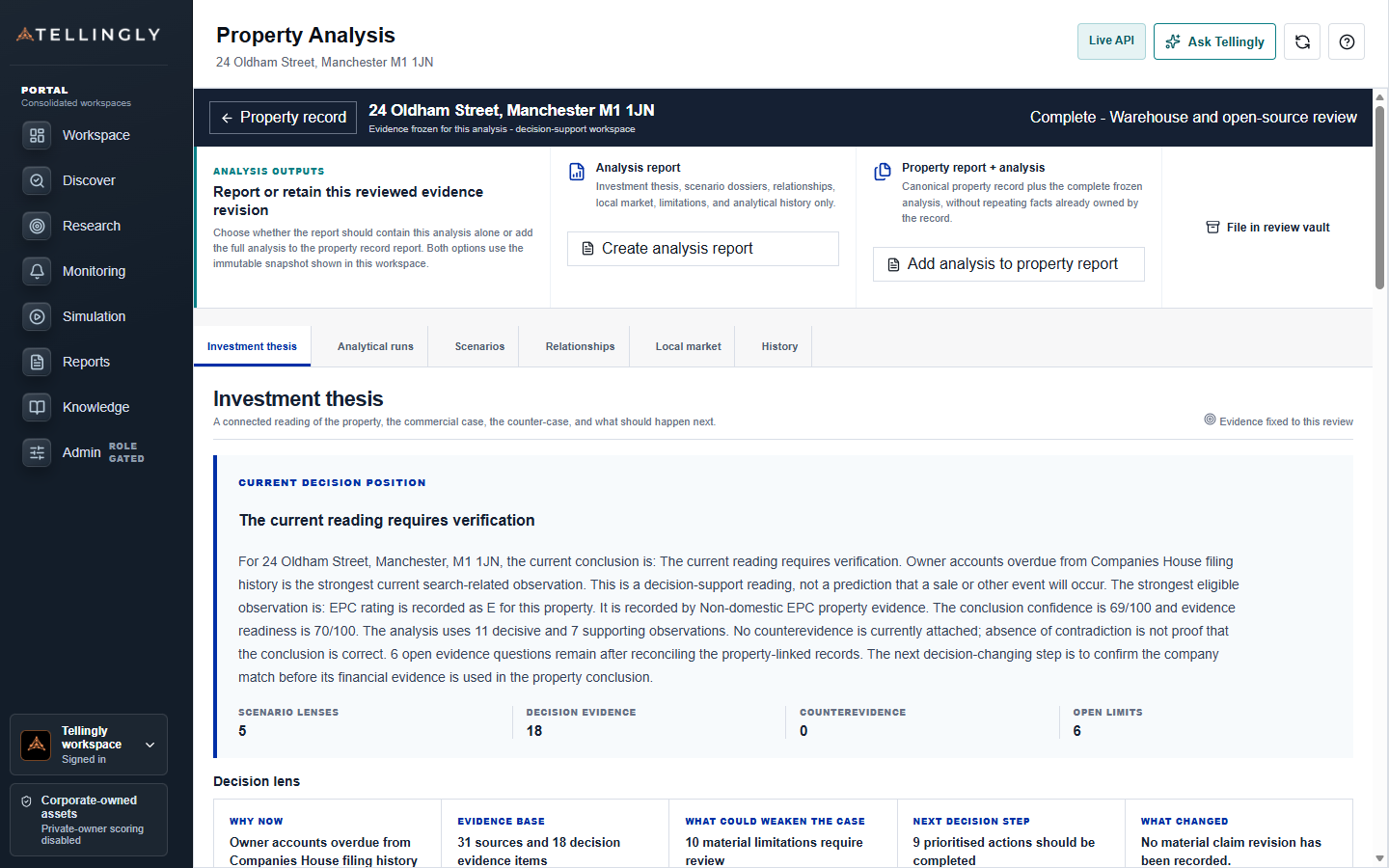
Compare the thesis, assumptions, downside, and next decision gate
The analytical workspace links the current thesis to scenario readiness, supporting evidence, counterevidence, financial inputs, risks, sensitivities, relationships, delivery dependencies, and unresolved gates. Each scenario can be reviewed independently, tested in Simulation Studio, and generated as a snapshot-bound dossier.
- Scenario-specific thesis and counter-case
- Evidence, assumptions, risks, and financial readiness
- Decision gates, simulation, and immutable dossier generation
- Primary question
- Which strategic option deserves further diligence?
- Evidence posture
- Every conclusion links to evidence or an assumption
- Decision output
- A comparable case, risk position, and gate plan
Only analyse scenarios the evidence can support
A scenario should answer a real strategic question: retain and operate, reposition commercial use, convert to residential or mixed use, pursue specialist or public-service reuse, redevelop, dispose, or monitor. Tellingly proposes options where the source evidence provides a credible basis and omits or clearly gates options that require unsupported assumptions.
When identity remains unresolved, the scenario is a contextual hypothesis for the supplied location. It can still explain demand, planning, supply, and verification priorities, but it cannot present local benchmarks as confirmed property economics.
The executive decision case
Each scenario begins with an introduction and executive summary written for a decision maker. It states the option, why it is relevant, the proposed operating or development concept, who the likely user is, how value could be created, the strongest support, the material counter-case, and the next decision gate.
The detailed sections then explain the analytical factors behind that position. Users can move between the decision case, evidence model, evidence and assumptions, financial case, risk register, sensitivity, delivery, and governance as distinct tabbed views.
- Decision thesis and management question.
- Current evidence reading and scenario fit.
- Conditions required for success.
- Reasons not to proceed and the first disconfirming test.
Financial feasibility without invented precision
The financial case uses direct facts where available, clearly labelled contextual benchmarks, deterministic derivations, and explicit analyst assumptions. Inputs can include floor area, rent, occupancy, operating costs, capital expenditure, programme, yield, financing, and value where their units and sources are valid.
Low, base, and high cases show how the result changes under different defensible inputs. Where the evidence cannot support a calculation, the missing variable is shown with its decision impact. The platform does not manufacture a point rent, yield, cost, or value simply to complete a model.
Sensitivity and uncertainty
Sensitivity analysis identifies the variables that most affect the case and the break-even points the board should understand. A deterministic comparison can show the effect of rent, occupancy, cost, value, and programme changes. Where empirical distributions are sufficient, a seeded probabilistic model can add percentiles and downside probabilities while retaining its distributions, run count, and assumptions.
Uncertainty is not hidden behind a single score. Scenario fit, evidence coverage, financial readiness, identity position, and model confidence remain separate so users can distinguish a promising concept from a calculation-ready investment case.
Scored risks and the counter-case
Material risks are organised by category and described relative to the scenario. Each risk can carry an evidence basis, likelihood, impact, velocity, current rating, mitigation, owner, target date, residual rating, early-warning indicator, and decision threshold.
Where evidence is limited, the risk can receive an explicitly conservative evidence-limited score rather than disappearing as unscored. The counter-case brings these risks together into a coherent reason not to advance and identifies what evidence could strengthen or overturn that view.
Delivery pathway and board output
The delivery view converts analysis into milestones and dependencies: confirm the subject, verify use and planning, obtain physical and income evidence, define capital and programme assumptions, test market demand, and secure the approvals required for the chosen route. Each gate can be assigned an owner and a target date.
The scenario dossier then records the executive case, evidence, calculations, risks, sensitivities, delivery plan, and governance ledger in one immutable artifact. It remains analytical decision support, not formal valuation, planning advice, design advice, or complete underwriting.