
How Tellingly turns source records into bounded intelligence
The methodology is designed to make property intelligence useful without erasing uncertainty: establish the subject, classify every observation by scope, preserve provenance and conflict, separate confidence measures, and freeze the evidence used for each decision.

The interface shows where every conclusion stops
Evidence governance is visible in the working product. Decision Evidence distinguishes conclusion confidence from evidence readiness, separates support from counterevidence, identifies unresolved gaps, and keeps the source path available for review.
Representative interface using demonstration data. The image illustrates the evidence-governance model described on this page.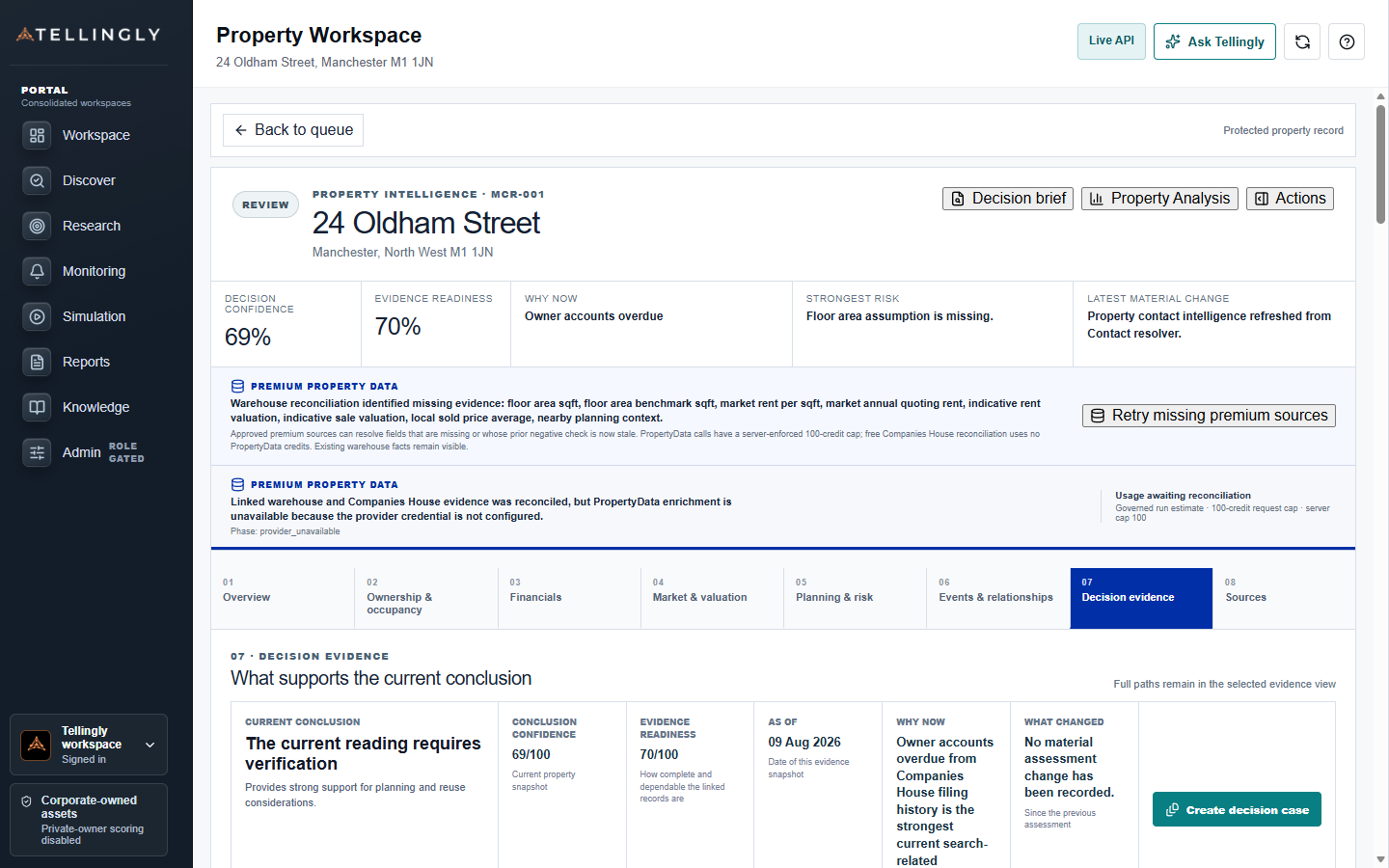
Follow the path from scoped observation to bounded finding
A reviewer first reads the current conclusion and why it matters, then inspects the observations that support or weaken it. Source scope, dates, linkage, confidence, and decision impact remain attached. Candidate and contextual evidence can be useful without silently becoming direct facts about the selected asset.
- Evidence scope travels with every observation
- Confidence, coverage, and match confidence remain distinct
- Frozen source path supports reproducible review
- Method
- Identity first, then facts, findings, and decisions
- Evidence rule
- Scope and provenance travel with every value
- Reproducibility
- Each decision is bound to an immutable revision
Establish the subject
Property intelligence begins with subject identity. Exact normalized UPRN and title evidence take precedence, followed by a canonical address across authoritative property records and corroboration from approved sources. Premise number, range, suffix, sub-premise, building, street, and postcode remain part of the comparison so a nearby unit is not promoted through postcode similarity alone.
Identity can be source-confirmed, analyst-confirmed, candidate-grade, conflicting, unresolved, partial, or failed. Candidate confidence is not the same as confirmed confidence, and an analyst confirmation records a governed decision rather than rewriting the source match as certain.
Classify every observation by scope
Every fact envelope identifies its subject, field, value, unit, semantic state, source, dates, revision, and scope. Direct observations describe the selected property or linked entity. Candidate observations may describe a plausible match. Building evidence describes the containing building. Contextual evidence describes a geography or peer set. Historical evidence describes an earlier state.
Scope controls display and eligibility. Candidate and contextual evidence can inform review and scenarios, but cannot silently become a direct property fact, headline score, valuation, owner, or occupier. Excluded evidence remains auditable with the reason for exclusion.
- Direct: confirmed subject-specific evidence.
- Analyst-confirmed: source-backed evidence accepted through an audited decision.
- Candidate: a plausible match awaiting confirmation.
- Contextual: a benchmark or place observation, not a property fact.
- Historical or stale: an observed earlier value retained with its date.
- Excluded: a record that cannot influence the current conclusion.
Reconcile sources without discarding disagreement
Where several eligible records describe the same field, the reconciliation order favours confirmed subject-specific linkage, the latest effective date, direct identifiers, and authoritative warehouse sources before approved enrichment or derived context. The effective date, observation date, and source release are considered separately.
Conflicting and historical values are preserved rather than silently choosing the first row. Stale observed data remains observed but stale. Missing, unknown, candidate, contextual, not applicable, withheld, and unresolved are different states and should not all be displayed as zero or not found.
Move from facts to findings
A finding states a conclusion and its implication, then references supporting evidence, counterevidence, and unresolved gaps. Evidence identity remains independent from claim identity so one source observation can support, weaken, or contradict different findings without being duplicated.
Reliance limits are closed only when their required fields have eligible canonical facts. Where a question remains open, the limit identifies the affected conclusion, the confidence impact, and the next action rather than repeating generic unresolved language.
Keep confidence measures separate
Report or decision confidence describes how strongly eligible evidence supports a conclusion. Evidence coverage describes how much required evidence is confirmed and current. Match confidence belongs beside the identity or relationship it describes. An opportunity score is shown only when the underlying decision evidence is eligible.
These measures answer different questions and should not be substituted for each other. Zero is reserved for a genuine measured zero; not run, unavailable, failed, unresolved, and candidate review use explicit states.
Freeze, reproduce, and review
An intelligence snapshot freezes the subject revision, canonical fact references, findings, relationships, source coverage, model revisions, and timestamps used by the workspace, Decision Brief, analysis, and reports. Downstream outputs refer to that snapshot rather than querying mutable latest data during generation.
Reports add a frozen presentation manifest, calculations, assumptions, narrative validation, quality checks, and output checksums. Historical artifacts remain byte-identical. This allows a reviewer to reconstruct the evidence position, distinguish observation from interpretation, and understand why the recorded decision was made.