Tellingly
Explore
Use cases

Workflows for teams that need earlier property intelligence

Users can enter Tellingly through a property, business, sector, geography, saved search, or emerging signal, then follow the evidence into the relevant workspace.

A multidisciplinary property team discussing evidence around a shared decision table.
Workflow in practice

Screen a candidate universe before opening a full record

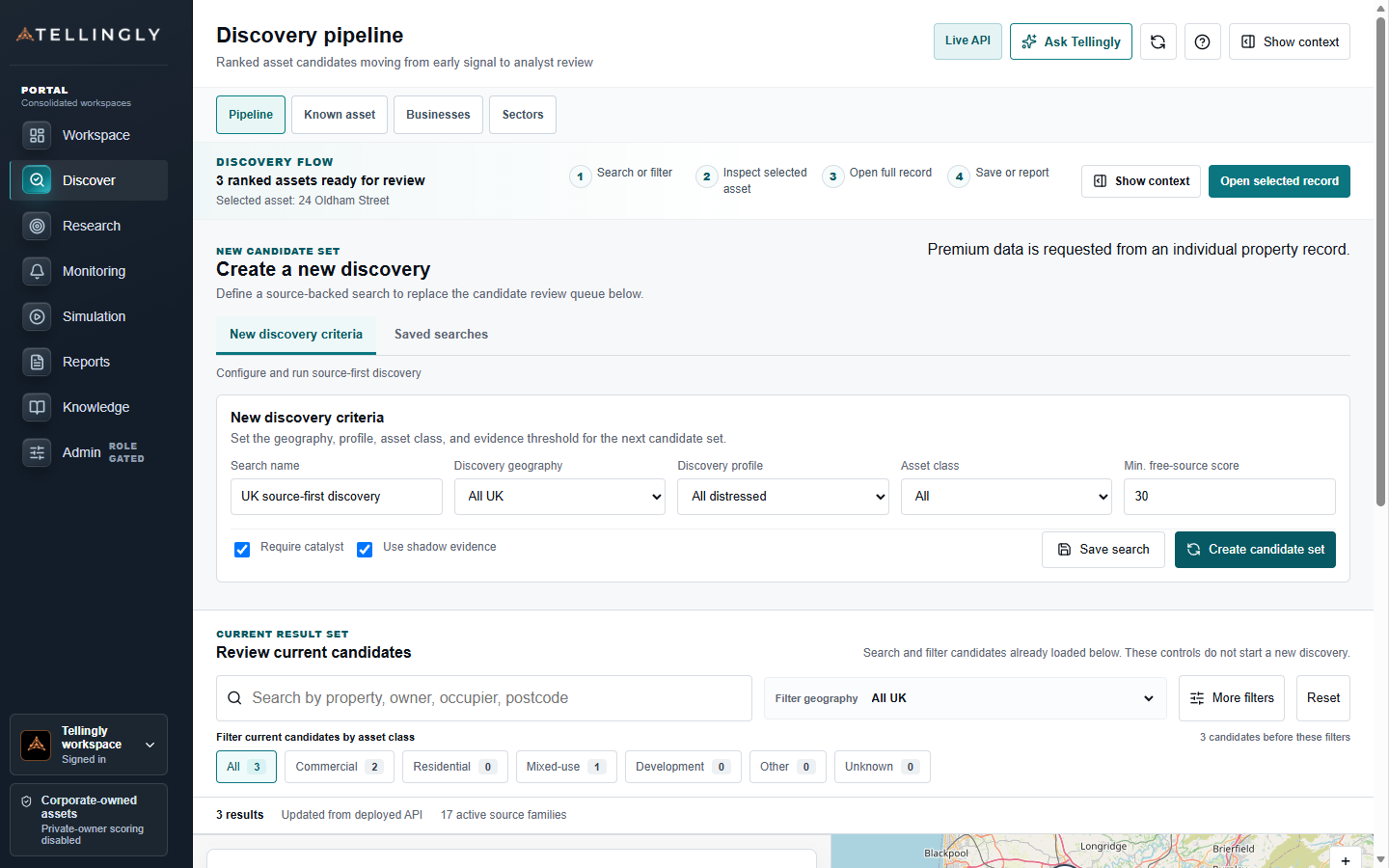
The Discovery Pipeline combines the search definition, qualification path, ranked candidates, selected geography, map, and the selected-asset context. This lets teams assess both the opportunity and the quality of the evidence that brought it into view.

Representative interface using demonstration data. The screen illustrates the workflow and evidence controls without exposing private search results.
Tellingly Discovery Pipeline showing search criteria, qualification coverage, ranked property candidates, geography filters, a map, and selected-asset context.
01

Compare rank, geography, catalyst, evidence, and location in one review

A user can define or rerun a search, inspect how many properties entered the candidate universe, see which qualification gates were met, and review the ranked queue beside a map. Search and filter controls act on the loaded candidate set; opening a record moves the selected property into deeper evidence reconciliation and analysis.

  • Search definition and qualification path
  • Ranked candidate queue with evidence posture
  • Map and selected-property context for rapid triage
View full interface
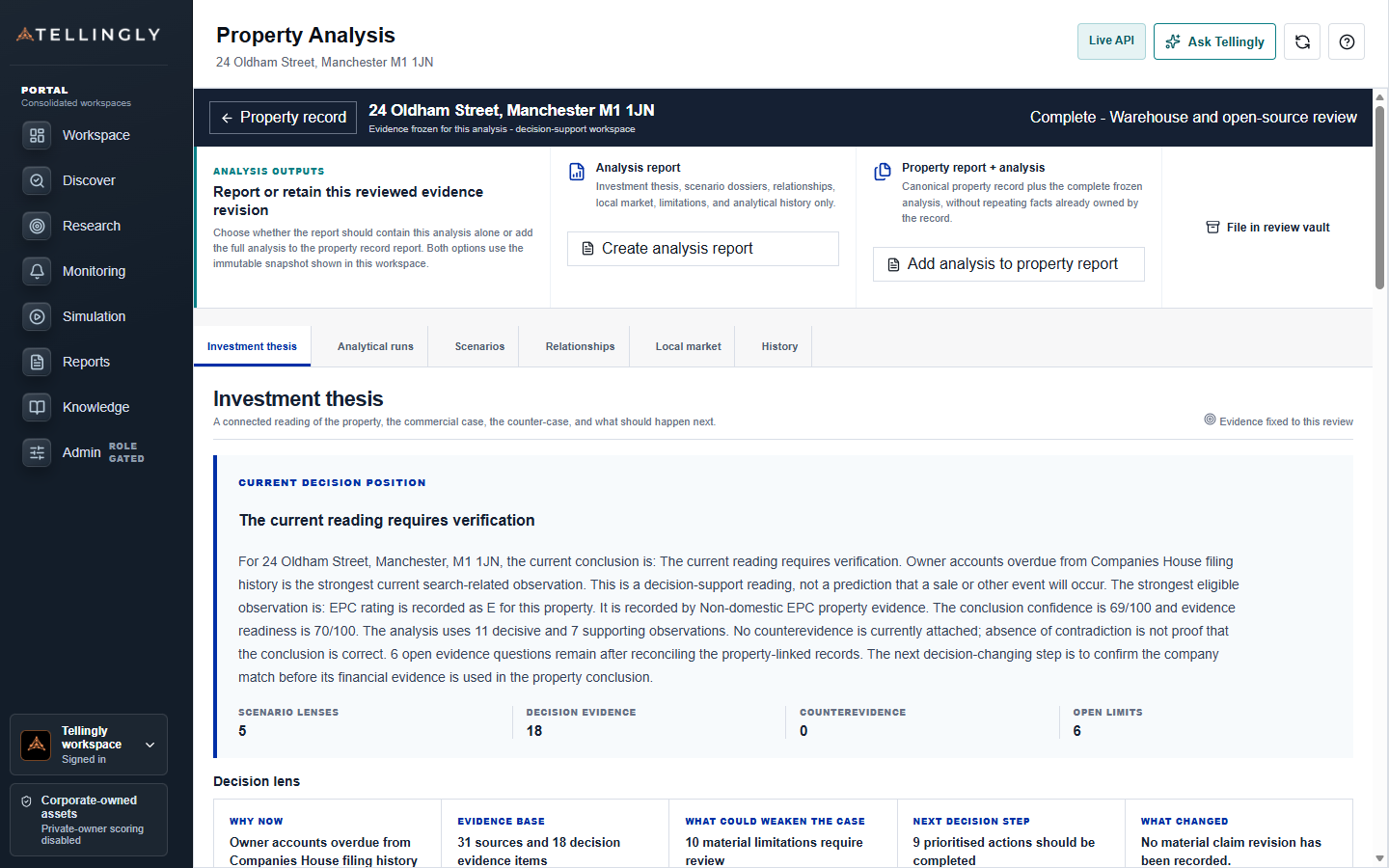
Tellingly Property Analysis showing an investment thesis, recommended action, evidence summary, scenarios, commercial implications, limitations, and report actions.
02

Turn a surviving lead into a reviewable commercial case

Property Analysis is used after the evidence record has been assembled. It connects the investment thesis, recommended action, why-now catalyst, downside, ownership and occupation, local-market evidence, scenarios, relationships, limitations, and the verification plan. Analysts can retain the review or create a snapshot-bound report from the same evidence position.

  • Connected investment thesis and downside
  • Scenario and local-market analysis
  • Review retention and immutable reporting
View full interface

Find and qualify opportunities

Special-situations, acquisition, advisory, and asset-management teams can screen for change, inspect why a property qualified, and focus diligence on evidence-backed candidates.

  • Property and asset discovery.
  • Owner and occupier research.
  • Sector and public-estate screening.
  • Monitoring, simulation, and report preparation.

Keep the counter-case visible

The workflow is designed to retain counterevidence, missing links, stale observations, and verification priorities alongside the commercial thesis. This supports review; it does not replace legal, valuation, planning, or investment advice.

Start from the question the team actually has

Acquisition and special-situations teams can begin with a geography, sector, corporate event, distress signal, planning change, or saved search. Asset managers can begin with a known property or monitored portfolio. Advisers and public-estate teams can begin with an owner, occupier, business, or service need.

Each entry point converges on the same discipline: identify the subject, show the evidence scope, preserve conflicting or incomplete records, and make the next verification or commercial action explicit.

Produce an output suited to the decision stage

Early screening may end with a rejected lead, a saved search, or a contextual watch item. A stronger candidate may move into a property record, premium enrichment, scenario analysis, monitoring, simulation, a review-vault file, or a board-oriented report.

The output becomes more detailed as the decision cost rises, while the complete evidence trail remains available to explain why the asset advanced, paused, or was removed from consideration.

03

Detailed workflows

Each workflow begins with a different analytical question and retains the relevant evidence boundaries.

Special-situations investors

For teams looking for assets where distress, transition, or under-managed ownership may create a route to acquisition.

Questions answered

  • Which assets have hard catalysts?
  • What evidence supports an approach now?
  • Which risks could make the lead a false positive?

Typical workflow

Run signal-led discovery, open the property record, then use full analytical mode for acquisition and exit scenarios.

Acquisition teams

For teams building a targeted pipeline across sectors, geographies, ownership profiles, and asset classes.

Questions answered

  • Where should we search next?
  • Which owners or occupiers repeat across the pipeline?
  • What changed since the last saved search?

Typical workflow

Save discovery searches, rerun them, compare result snapshots, and shortlist assets for deeper research.

Brokers and advisors

For advisors who need a structured evidence pack before deciding whether an asset or company warrants outreach.

Questions answered

  • What is the likely reason for opportunity?
  • Who owns or occupies the site?
  • What evidence can be discussed with a client?

Typical workflow

Use the lead queue and source-audited property record to prepare client-facing diligence notes.

Lenders and restructuring teams

For teams monitoring borrowers, guarantors, occupiers, or security-linked assets for early signs of risk.

Questions answered

  • Which borrower-linked assets changed?
  • Is weakness owner-led or occupier-led?
  • What needs verification?

Typical workflow

Monitor watchlists, review owner and occupier financial health, and export false-positive learning back into the model.

Asset managers

For teams tracking tenant quality, capex exposure, and repositioning or disposal opportunities across a portfolio.

Questions answered

  • Which assets need tenant review?
  • Where is capex or compliance pressure building?
  • Which properties should move to watch?

Typical workflow

Use property records, occupier profiles, EPC/VOA context, and analyst feedback to prioritise management action.

Sector researchers

For users who begin with a struggling sector, then want to map companies and operators back to physical assets.

Questions answered

  • Which sectors look weak?
  • Which companies are exposed?
  • Can those companies be mapped to properties?

Typical workflow

Run sector intelligence, inspect company seeds, then launch sector-led asset discovery.