
Find the assets that deserve an analyst's attention
Opportunity discovery converts a broad set of property, corporate, market, planning, and event signals into a reviewable candidate queue—then explains why each asset is there and where the evidence may be weak.

See the search definition, evidence path, and ranked queue together
Discovery records the search scope, qualification rules, returned universe, ranked candidates, geography, mapping coverage, and evidence context needed to understand why each lead appeared.
Representative interface using demonstration data from the protected analyst portal.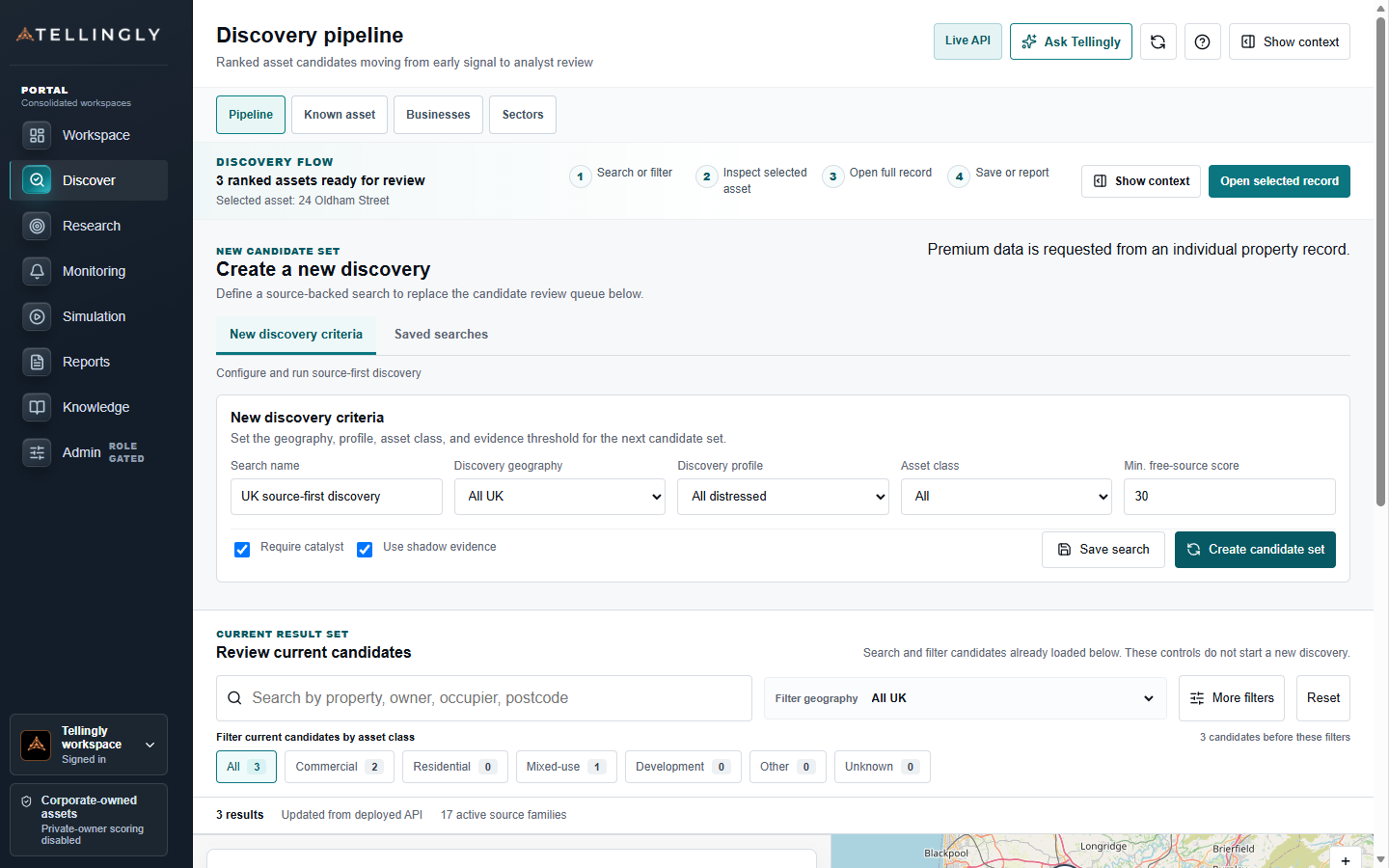
Interrogate the candidate set before committing diligence effort
The Discovery Pipeline shows the latest completed run, qualification totals, current result filters, a ranked lead queue, and mapped property context. Users can compare candidates, inspect the selected asset, revisit the exact search, or open the full record without losing the run that created the opportunity set.
- Candidate universe and qualification counts
- Ranked evidence-backed lead queue
- Geography, map coverage, and selected-asset context
- Primary question
- Which assets warrant review now?
- Analytical unit
- A governed candidate set, not a loose list
- User outcome
- A prioritised queue with reasons and gaps
The discovery question
The first task is not to predict a transaction. It is to identify assets where observable change justifies scarce analyst time. A useful discovery process must therefore balance sensitivity with discipline: it should surface relevant change without presenting every contextual indicator as distress or every address match as a confirmed property.
Tellingly builds a candidate universe for the chosen geography, profile, asset class, and evidence threshold. It records the qualification path for returned and contextual candidates so users can understand both inclusion and exclusion.
Signals, catalysts, and corroboration
Signals can originate from property records, title and ownership data, corporate filings, insolvency and legal events, planning activity, regulatory information, market movements, source readiness, or other approved evidence families. Their analytical meaning depends on whom and what they describe.
A hard catalyst may justify urgent review when it is directly linked and current. A softer sector or local-market indicator may strengthen context but should not create a property-level distress conclusion on its own. The queue preserves these differences instead of reducing them to an unexplained rank.
- Direct property and entity events are distinguished from area and sector context.
- Supporting signals and counter-signals are retained together.
- Source dates, geography, linkage, and confidence remain inspectable.
- Candidate-grade occupiers or owners cannot silently drive a headline conclusion.
Qualification and ranking
Qualification establishes whether a candidate meets the active gates. Ranking then orders the visible results using only eligible evidence for that run. The two operations are related but not interchangeable: an asset may be visible for contextual review without satisfying every hard gate, and a high rank may reflect relative position within the current set rather than an absolute investment judgement.
The selected-asset context explains the current reading, strongest supporting evidence, counter-signals, identity position, and next checks. If evidence is insufficient for a numeric decision score, the interface should describe the reason and show any valid contextual or provisional measure without labelling absence as zero.
A review queue that remains usable
Analysts can search and filter the loaded result set without inadvertently starting a new discovery. Asset-class controls, geography controls, counts, map markers, and the selected context all relate to the same completed run. Changing to another workspace should not destroy that result state; a new set is loaded only when the user creates or selects one.
The map is a review aid rather than decorative geography. Markers use the same bands and colours as the legend, selected assets are identifiable, and missing coordinates are presented as a verification issue rather than a misleading point.
Counterevidence and false-positive control
A discovery system becomes less useful when it rewards noisy evidence. Tellingly therefore keeps owner diversification, weak entity linkage, stale observations, sector generalisations, and missing property confirmation visible as counter-signals or reliance limits.
Analysts can see why a candidate is contextual, what evidence would change its position, and whether the apparent catalyst belongs to the owner, occupier, a related group company, or the wider location. This is particularly important where financial difficulty exists but cannot yet be attributed to the entity controlling or occupying the asset.
From candidate to controlled handoff
Opening a selected record hands the property and its evidence revision into Property Intelligence. Premium enrichment, deeper analysis, monitoring, and report generation occur in the appropriate downstream workspace rather than being hidden side effects of browsing the queue.
The discovery output is therefore a traceable shortlist: the search definition, candidate universe, qualification gates, visible set, selected asset, and decision to advance or reject can all be revisited.