Observe change
Detect movement across companies, ownership, occupation, planning, property condition, market context, and local demand.


Tellingly brings signal-led discovery, property identity, ownership and occupancy evidence, market context, scenario analysis, and board-ready reporting into one accountable research workflow.
The workspace is the analyst's starting point. It brings active research, monitored assets, source warnings, saved work, portfolios, and recent reports into one ordered view before the analyst moves into a specialist workflow.
Representative interface using demonstration data from the protected analyst portal. No private customer or property record is published.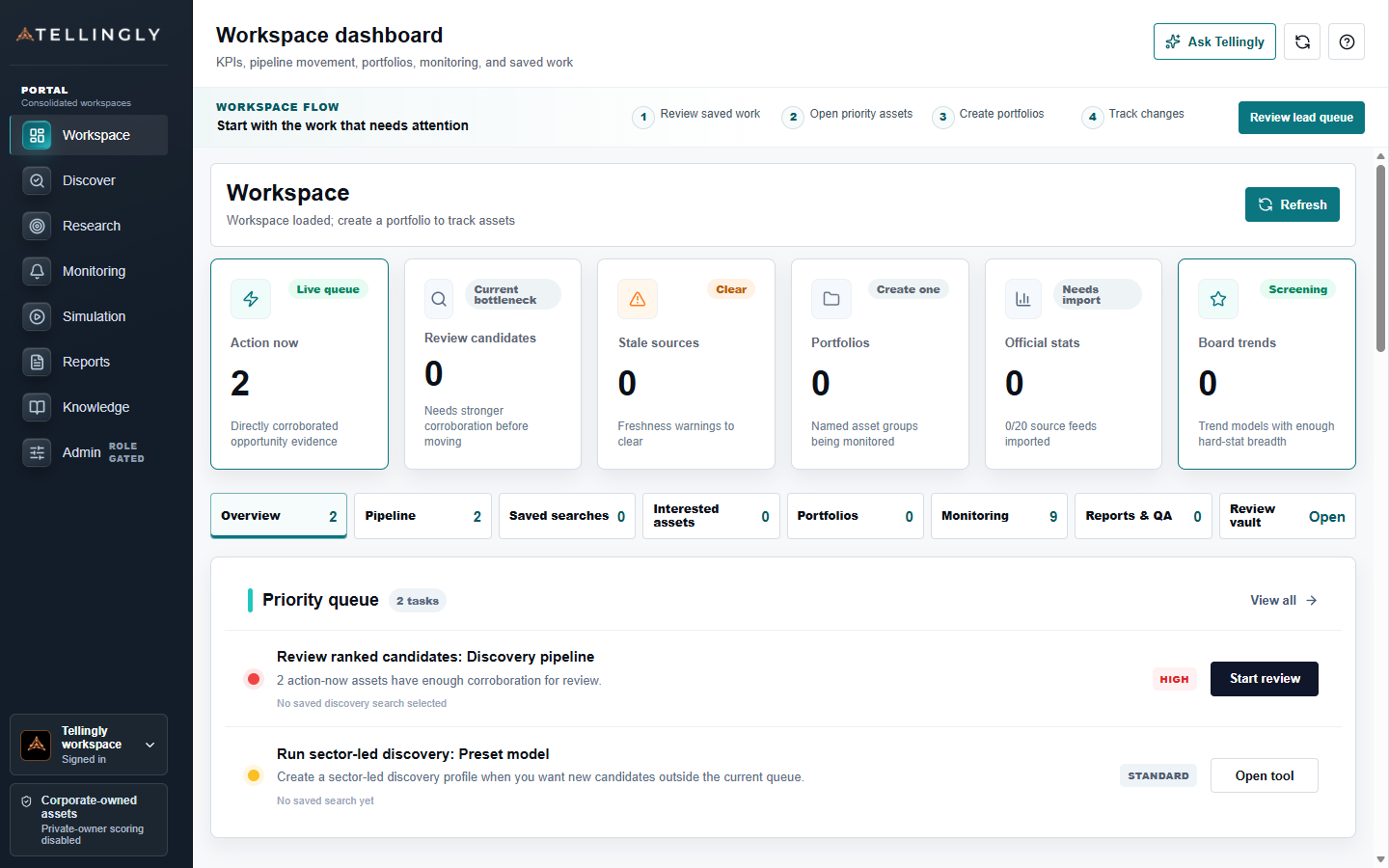
The workspace distinguishes urgent review from saved reference material. An analyst can see the live opportunity queue, monitoring changes, source readiness, retained research, portfolios, and report activity without opening several disconnected products. The screen answers three practical questions: what changed, which evidence is ready, and where should work continue?
Start with a change in an owner, occupier, sector, location, or asset. Tellingly keeps the supporting evidence and its limitations visible while an analyst decides whether the lead deserves more work.
The public site explains the approach. The private portal is where authorised analysts run discovery, inspect source-linked records, test scenarios, and preserve their review.
Property facts, contextual benchmarks, candidate matches, and unresolved questions are treated as different evidence states. That distinction helps teams avoid turning an interesting signal into an unsupported conclusion.
Ownership, occupation, corporate health, planning, condition, valuation context, local demand, and material events are reviewed together without collapsing their different scopes or confidence levels.
A single evidence trail follows the analyst from broad discovery into the selected asset, its scenarios, and the final board artifact.
Detect movement across companies, ownership, occupation, planning, property condition, market context, and local demand.
Anchor the property, title, UPRN, owner, occupier, and geography before candidate or contextual records are treated as direct evidence.
Join warehouse, official, open-source, and approved premium observations while retaining dates, scope, lineage, conflicts, and missing fields.
Compare the commercial thesis with counterevidence, alternative-use scenarios, sensitivities, risks, and explicit decision gates.
Preserve the evidence revision, analyst judgement, next action, monitoring state, and report artifact for accountable later review.

Tellingly keeps source records, identity matches, dates, geography, freshness, contradictions, and unresolved questions close to the conclusion. Analysts can see what is confirmed, what is only plausible, and what should happen next.
See the intelligence modelTechnical evidence is translated into review surfaces designed for different moments in the process.
A plain-English conclusion, decisive evidence, counter-case, confidence boundary, and next unresolved action.
A canonical record covering identity, ownership, occupation, financials, market, planning, relationships, evidence, and sources.
Evidence-bound cases for acquisition, retention, repositioning, alternative use, financing, or exit—with assumptions and risks exposed.
Snapshot-bound board packs and due-diligence artifacts whose evidence, narrative, HTML, and PDF remain reproducible.
Every retrieved record is assigned an explicit scope. Candidate and contextual evidence can inform review without silently becoming a fact about the selected property.
Direct, source-linked evidence about the selected subject.
A plausible match retained for analyst confirmation, never silently promoted.
Building, postcode, local, regional, or sector evidence that frames the case without becoming a property fact.
A transparent calculation or analytical interpretation with its inputs and revision attached.
A material question that remains visible and constrains confidence or action.

Local supply, population change, accessibility, business activity, public services, planning movement, and comparable evidence help explain where an asset sits—while remaining visibly separate from direct property facts.
Explore team workflowsTeams enter through different questions, but each workflow preserves the same evidence boundaries and audit trail.
Identify properties or occupiers that deserve early commercial review.
Create targeted watchlists from signals, sectors, geographies, and occupier profiles.
Understand the business context behind a tenant, operator, or potential opportunity.
Track change across sectors, locations, ownership structures, and property-linked activity.
Request access to run discovery, resolve a known asset, review evidence, test scenarios, and create immutable decision-support reports.
Research support, not formal advice. Independent legal, valuation, planning, lending, tax, and investment review remains essential.