Owner financial pressure
Companies House filings, accounts timing, corporate events, charges context, insolvency indicators, and financial-health breadcrumbs.

Tellingly separates observed facts from candidate matches and contextual indicators, so analysts can see why a lead is visible, why it may be wrong, and what still needs checking.

Decision Evidence is designed to make an analytical argument inspectable. It presents the current conclusion in plain language, then separates decisive support, corroborating context, counterevidence, and the questions that still constrain confidence.
Representative interface using demonstration data. Source names, counts, and conclusions shown in the image are illustrative of the product workflow rather than public claims about a live customer asset.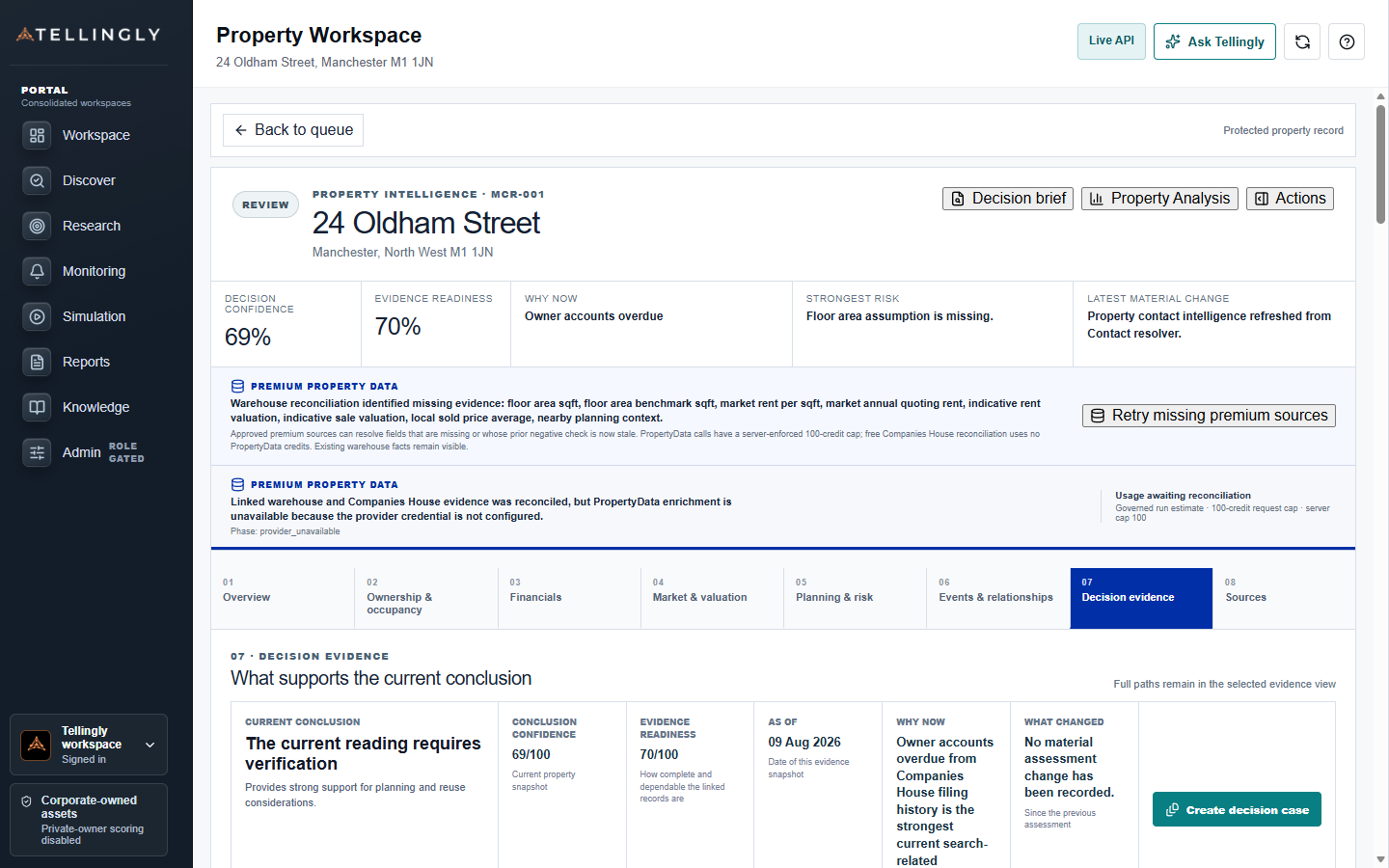
The view gives reviewers a synopsis before exposing the technical evidence path. Confidence and evidence readiness are kept distinct, a material trigger is identified, and the strongest risk remains visible. Reviewers can then inspect supporting observations, counter-signals, unresolved questions, and the provenance attached to each part of the decision.
A property can be affected by evidence about its legal owner, operating occupier, physical characteristics, local market, planning position, or surrounding sector. The platform keeps those roles separate and records how each source was linked.
An opportunity score is displayed only when its underlying evidence meets the required eligibility rules. Missing or candidate-grade evidence should reduce confidence or remain outside the conclusion rather than silently becoming a fact.
A source row first becomes an observation with a subject, scope, date, geography, match method, freshness, and provenance. Reconciliation determines whether it is direct, analyst-confirmed, candidate, building-level, contextual, historical, conflicting, or excluded.
Findings then reference the eligible observations that support or weaken them. This keeps the source identity independent from the claim and allows the same observation to play different roles without being duplicated or silently promoted.
A decision-ready view should allow a reviewer to state the current conclusion, why the asset matters now, the strongest supporting evidence, the material counter-case, the confidence of the conclusion, the coverage of required evidence, and the next action needed to improve the case.
The technical graph, table, source register, and timeline remain available for detailed inspection, but the first reading is structured as an argument that can be communicated to colleagues and decision-makers.
The platform connects company behaviour, occupier evidence, asset data, and local-market context.
Companies House filings, accounts timing, corporate events, charges context, insolvency indicators, and financial-health breadcrumbs.
Occupier identity confidence, tenant weakness, regulatory register evidence, sector exposure, and company health where available.
EPC, VOA/rateable value, planning activity, title enrichment, use class, capex pressure, and local constraints.
Sector presets, SIC logic, local business density, insolvency trends, closures, and geography-specific context.
Indicative pricing, rent, demand, growth, floor-area, and comparable context where reliable source coverage exists.
Every lead separates confirmed evidence, interpretation, missing evidence, dampeners, and next verification steps.
Precision matters more than volume. Weak context should not outrank real catalysts.
Events such as insolvency, receiver activity, direct disposal evidence, vacancy, or serious accounts distress can move a lead into action review.
Planning movement, EPC pressure, rateable value burden, sector stress, or late filings strengthen a thesis but should not carry a lead alone.
Strong owners, weak source coverage, unconfirmed asset class, or ambiguous occupier identity reduce confidence.
Newer signals can be observed and tested before they affect live ranking.
The platform makes the boundary between a direct observation and supporting context visible wherever the evidence is used.
Direct, source-linked evidence about the selected subject.
A plausible match retained for analyst confirmation, never silently promoted.
Building, postcode, local, regional, or sector evidence that frames the case without becoming a property fact.
A transparent calculation or analytical interpretation with its inputs and revision attached.
A material question that remains visible and constrains confidence or action.
The product shows evidence, caveats, counterevidence, and missing data so an analyst can decide what to verify next—and explain that decision later.
See workflows