
Understand the asset in its market, planning, and place context
Tellingly joins property-level evidence to the market, planning, physical, demographic, access, and competitive context needed to assess whether an apparent opportunity is credible—and clearly labels the scope of every observation.

Connect the selected asset to its commercial and physical context
The property record and analysis workspace combine direct asset evidence with labelled building, comparable, catchment, local-authority, regional, and national context. Each statistic retains its geography, period, unit, sample, and provenance.
Representative interface using demonstration data. Contextual statistics shown in the product remain separate from direct property facts.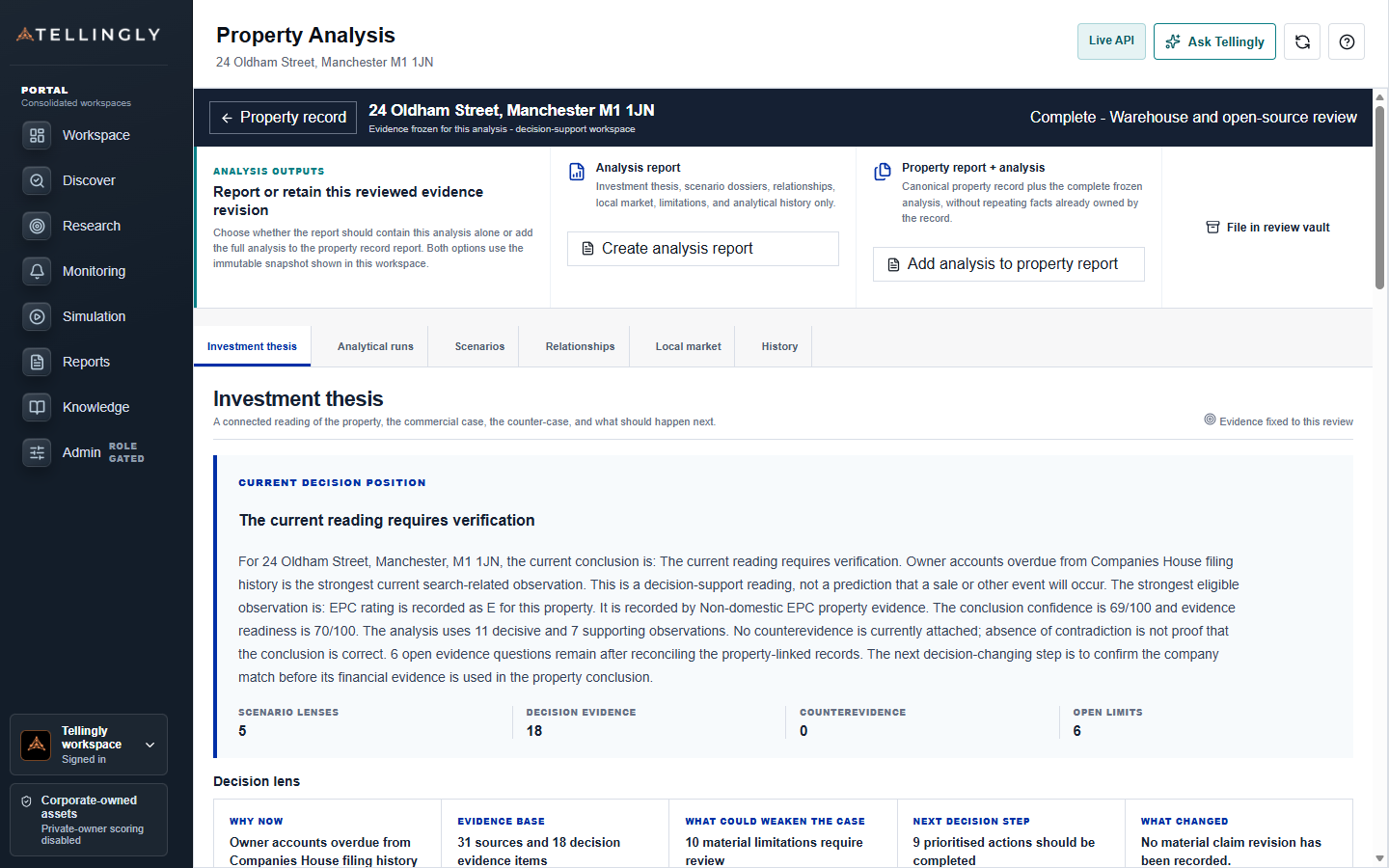
Read property evidence alongside the local-market case
Property Analysis brings market, planning, use, physical, relationship, and local-demand evidence into an integrated commercial reading. Analysts can see where the property-specific case is strong, where a conclusion relies on local benchmarks, and which planning, income, physical, or access questions must be verified before advancing an option.
- Direct facts and contextual benchmarks kept separate
- Local demand, planning, use, access, and physical evidence
- Commercial implications tied to verification actions
- Primary question
- Does the property and its location support the proposed use?
- Analytical control
- Direct facts and contextual benchmarks stay separate
- Decision output
- Market case, constraints, counter-case, and checks
An integrated place reading
A property cannot be assessed only through its title or only through area statistics. The relevant commercial reading connects the selected premises to its price and rent evidence, planning position, physical characteristics, accessibility, surrounding demand, competing supply, and wider economic context.
Tellingly organises these observations by scope so the user can see which statements describe the property, its building, its postcode, the local authority, the region, or a national benchmark. This makes context useful without turning it into false precision.
Pricing, rents, and comparables
Market review can include observed transactions, HMLR Price Paid evidence, commercial rents, rateable values, floor-area observations, price and rent indices, local distributions, nearest comparables, and approved premium-source indications. Each record carries its date, unit, geography, subject relationship, and provenance.
Where sufficient evidence exists, the workspace can display median, mean, range, count, period, and trend. Comparable selection remains reviewable: nearby does not always mean comparable, and a transaction for another unit or use class cannot silently become a direct valuation input.
- Property-specific observations appear before building and geographic benchmarks.
- Sample size and date range accompany distributions and trends.
- Outliers and conflicting observations remain visible in the evidence record.
- Modelled indications state their inputs, uncertainty, and screening purpose.
Planning and use
Planning evidence is presented as a dated record rather than a single count. Applications can be reviewed by status, type, description, distance, relationship to the subject, and decision date. Current use-class and rating evidence helps frame the existing position, while policy and nearby precedent can inform—not guarantee—alternative-use analysis.
The workspace distinguishes a property-linked application from a nearby application and a granted permission from an implemented scheme. A scenario that depends on change of use or redevelopment carries that dependency into its decision gates and delivery plan.
Physical, environmental, and access constraints
Physical analysis can include floor area, EPC and MEES evidence, site or building characteristics, environmental and flood context, transport access, local infrastructure, and other display-approved constraints. These sources help identify verification priorities and potential capital or programme implications.
They do not replace a measured survey, environmental report, structural investigation, transport assessment, or statutory search. The user sees both the current indication and the professional or source-specific check required before reliance.
Demand, demographics, traffic, and competition
Place evidence can include population structure and change, household projections, economic activity, business counts, service demand, traffic flows, transport nodes, points of interest, competitor density, and supply indicators. The analytical value comes from comparison: the selected catchment should be read against the relevant local, regional, and national benchmarks.
Each statistic is interpreted relative to a proposed user or operating concept. Population growth alone does not prove demand for a specific use, and a high traffic count does not prove conversion into visits or revenue. The scenario must connect the observed indicator to a credible demand proposition and retain the counter-case.
From context to a decision boundary
The output brings together the strongest market support, planning pathway, physical constraints, demand indicators, counterevidence, and unresolved inputs. Visuals may include distributions, trends, timelines, comparisons, maps, and evidence coverage where the underlying data supports them.
The conclusion remains bounded by identity and scope. If the exact premises are unconfirmed, Tellingly can provide a contextual location assessment but should not describe area benchmarks as property economics or issue an ungated property opportunity score.