
Resolve who owns, occupies, operates, and controls the asset
Ownership and occupancy research combines property, company, premises, regulatory, rating, and observed trading evidence while preserving the difference between a legal title, a registered address, an operating business, and an occupier.

Keep the legal owner, operating occupier, and candidate match distinct
Ownership and occupation are reviewed inside the same property record but remain separate evidence questions. The interface shows confirmed identities, candidate relationships, source scope, confidence, and unresolved checks.
Representative Property Workspace using demonstration data; identities visible in the screenshot are not published customer records.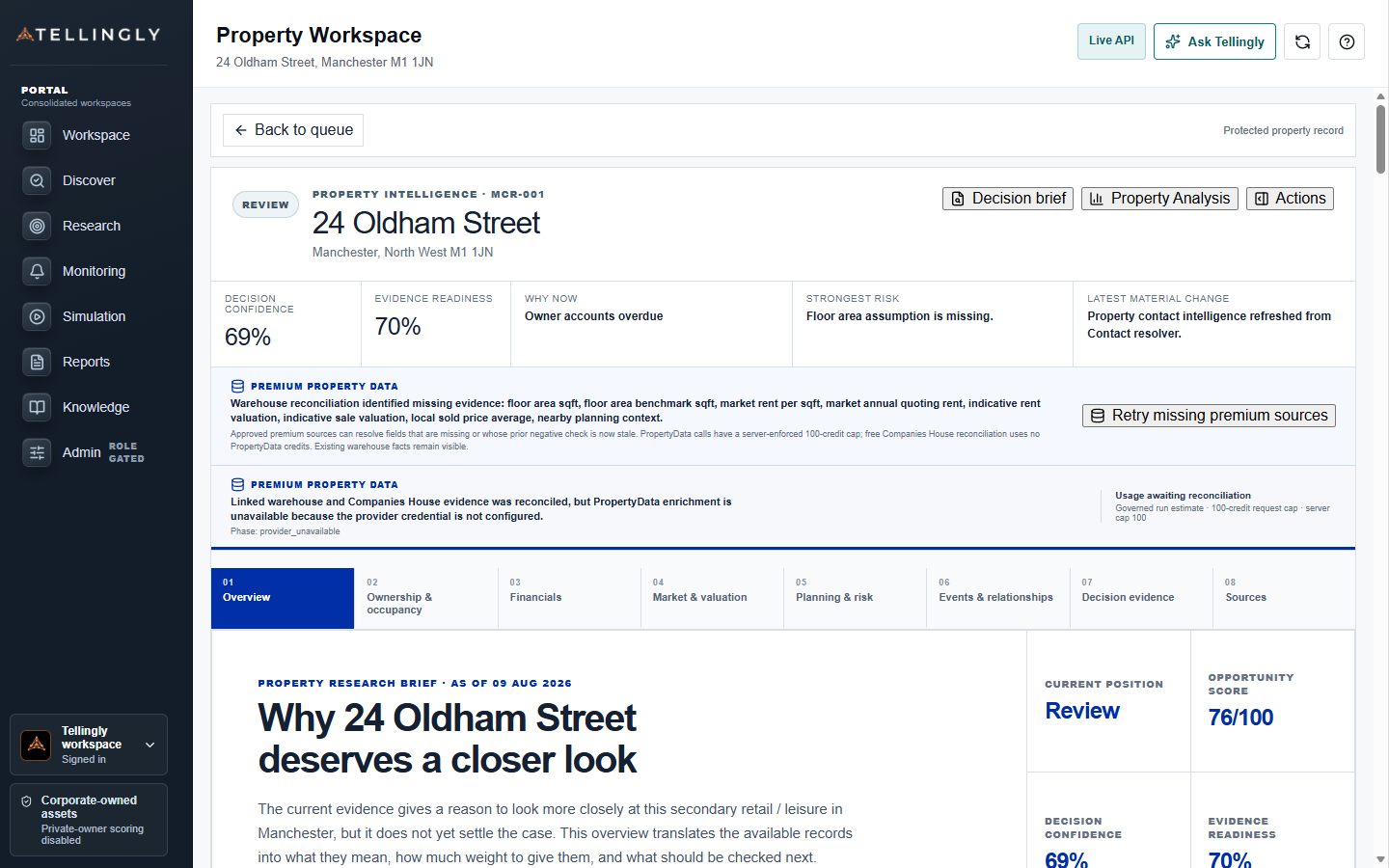
Move from a property anchor to the organisations connected to it
The workspace begins with a confirmed or candidate property identity, then separates title ownership, owner-company evidence, observed premises names, possible occupiers, contacts, and relationship records. A reviewer can inspect the matching basis before an entity influences a financial assessment, distress finding, scenario, or report.
- Owner and occupier treated as different roles
- Candidate matches remain visibly review-grade
- Source inspection before decision use
- Primary question
- Which entity has which relationship to the premises?
- Core control
- A company-at-address match is not occupancy proof
- Decision output
- Confirmed roles, candidates, conflicts, and checks
Why role separation matters
The registered proprietor controls the legal title, but may not occupy the premises. A leaseholder may occupy part of a multi-let building. A trading name may identify the venue while a different legal company operates it. A registered office may be an accountant, agent, virtual office, or group headquarters with no operational presence.
Tellingly records these as distinct relationship types. This prevents a company event from being attributed to a property simply because the company appears at the same postcode and prevents owner-level financial evidence from being described as occupier evidence.
The resolution hierarchy
Property identity is established first through normalized UPRN, title number, canonical address, and corroborating authoritative records. Ownership is then anchored to current title or approved property evidence. Occupancy is assessed separately through lease or rating evidence, premises registrations, regulatory records, observed trading information, and company-address context.
The system records whether each relationship is direct, analyst-confirmed, candidate, building-level, contextual, historical, or excluded. A strong address similarity can produce a candidate, but it does not automatically make that candidate eligible for a financial conclusion.
- Exact identifiers take precedence over postcode or text similarity.
- Current authoritative property evidence takes precedence over derived projections.
- Two independent sources can corroborate a relationship where policy permits.
- Conflicting and historical identities are retained rather than silently overwritten.
Candidate review without hidden assumptions
When no confirmed occupier is available, the workspace should not stop at a message that context exists. It presents the strongest premises or company candidates, their source, address, role, match method, confidence, observed date, and reason they remain unconfirmed.
An authorised analyst can confirm a source-backed candidate with a recorded reason. That action creates an audited analyst-confirmed relationship; it does not inflate the original source-match confidence or erase competing candidates. Later authoritative evidence can upgrade the relationship while preserving the analyst decision history.
Companies House and financial attribution
Companies House can help identify companies registered at an address, corporate groups, directors, filings, charges, and financial accounts. It cannot, by itself, prove that the company physically occupies the premises or that its financial condition affects the asset in the same way as a tenant's condition.
Financial evidence is therefore used only after the entity relationship is established to the required grade. The workspace explains whether the accounts belong to the owner, confirmed occupier, candidate occupier, related company, or address-only company and whether that evidence is eligible for a headline conclusion.
Edge cases the workflow must expose
Multi-let buildings, serviced offices, shopping centres, business parks, group-company structures, franchise operations, public-sector sites, vacant premises, property managers, and venue trading names all create legitimate ambiguity. A useful research workflow shows that ambiguity rather than forcing a single entity into every role.
For each edge case, the user can inspect the premises unit, building context, address normalization, source scope, and conflict. The next action may be to obtain lease evidence, check a regulator or rating record, review recent accounts, contact the premises, or confirm the relationship through an approved source.
Decision-ready output and limitations
The output is a readable role map: who owns the title, who appears to occupy or operate the premises, which companies are merely associated with the address, how confident each link is, and what evidence supports it. Relationship diagrams and prose interpretations can then show how verified entity evidence affects the commercial case.
This remains research evidence rather than legal confirmation of title, lease, occupation, or beneficial ownership. Material decisions should be checked against current title documents, leases, authoritative registrations, and appropriate professional advice.